
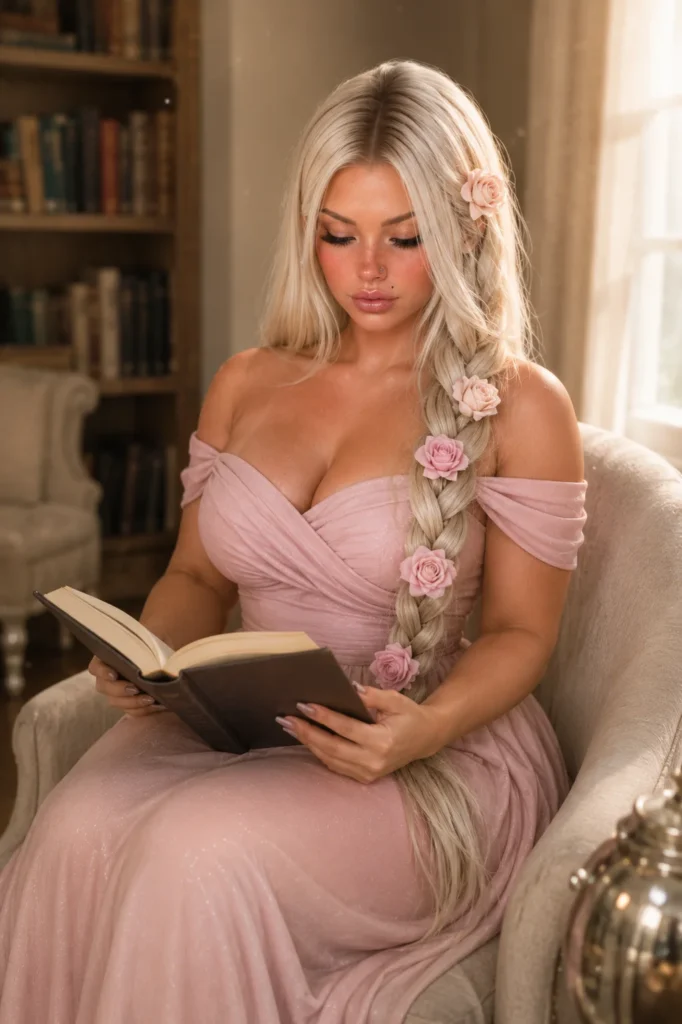
Mulher lendo livro em uma atmosfera romântica e cinematográfica é o tipo de cena que imediatamente prende o olhar. A combinação entre iluminação suave, composição elegante e detalhes delicados transforma essa imagem em uma referência visual poderosa para quem busca inspiração estética em retratos criados com IA.
Um retrato delicado e cinematográfico
A cena apresenta uma mulher sentada confortavelmente enquanto segura um livro aberto em um ambiente sofisticado e acolhedor. O vestido rosa claro, os cabelos longos adornados com flores e a luz natural entrando pela janela criam uma estética suave, refinada e emocional.
O fundo desfocado reforça o aspecto editorial da composição, trazendo profundidade visual e sensação de intimidade. Cada detalhe contribui para uma imagem que mistura romantismo moderno, fotografia fine art e atmosfera literária.
Prompt gratuito para copiar
Se você deseja recriar esse estilo visual em suas próprias gerações, existe um prompt gratuito pronto para copiar inspirado exatamente nessa composição. Ele ajuda a reproduzir a iluminação cinematográfica, a estética delicada e o clima elegante presentes na imagem.
Essa referência funciona especialmente bem para retratos femininos realistas, cenas de leitura, estética cozy luxury, personagens delicadas e conteúdo visual para Pinterest ou capas editoriais.
Variações visuais e inspirações
A mesma proposta pode ser adaptada para cenários vintage, quartos clássicos, bibliotecas luxuosas ou estilos mais sombrios e dramáticos. Também funciona muito bem em versões fine art, editorial fashion e retratos hiper-realistas.
Uma imagem que transforma silêncio, beleza e narrativa visual em pura inspiração estética.
Prompt da imagem
Prompt 112:
Vertical portrait composition with a seated adult subject positioned slightly right of center in the foreground, framed from approximately mid-thigh upward. Camera angle is slightly above eye level with a soft depth-of-field effect causing the background to appear blurred. The subject is seated on a light upholstered chair with the torso angled slightly toward the right side of the frame while the head tilts downward toward an open book held in both hands. The face is turned slightly left relative to the camera, with the gaze directed downward at the pages. The left shoulder is positioned closer to the camera. The posture is upright with relaxed shoulders and bent elbows resting near the torso.
Both hands hold an open hardcover book near lap level. The right hand supports the lower outer edge of the book with fingers curved underneath the cover, while the left hand supports the opposite side with fingers partially wrapped around the lower edge. The book pages are slightly fanned open and angled upward toward the face.
The subject wears a pale matte fabric dress in a light pink tone. The garment has an off-shoulder neckline with folded sleeve bands resting around the upper arms. The bodice features overlapping gathered fabric panels crossing diagonally at the front with visible seam structure and tension folds. The waist transitions into a flowing skirt with soft vertical draping and smooth fabric texture. The surface of the fabric contains subtle reflective speckling visible in highlights. No visible patterns are present.
Hair is long, thick, and styled into a loose side braid draped over the front of the left shoulder and extending downward across the torso. The hairstyle includes soft waves and loose strands framing both sides of the face. Several rose-shaped floral accessories are attached along the braid at spaced intervals, including one near the upper side of the head and multiple attached along the braid length. The flowers are light pink with layered petals.
Visible facial structure includes softly arched eyebrows, partially closed eyelids with visible eyelashes, a narrow nose bridge, and closed lips with defined contour. The jawline is softly rounded. Makeup details include even skin tone, lightly defined eyelashes, subtle pink-toned eyelids, and matte lip color. No visible facial jewelry or eyewear.
No visible tattoos. Fingernails appear short to medium length with a natural or pale finish. No visible rings, bracelets, necklaces, or earrings.
The environment is an indoor room with soft neutral-toned furnishings. Behind the subject on the left side of the frame is a tall bookshelf extending vertically with multiple shelves containing books of varying heights and muted colors. In the midground left is a blurred upholstered chair. On the right side of the frame is a bright window area producing soft natural light entering from the right side, creating gentle highlights on the subject’s face, shoulders, hair, and dress. The background includes cream and beige wall tones with diffuse shadows. The chair the subject sits on has rounded upholstery and light fabric texture. A reflective metallic object is partially visible in the lower right corner with soft distorted reflections. Small illuminated dust-like particles are visible throughout the foreground and midground due to backlighting.

Use the uploaded reference person as the identity and body-shape source. The reference defines the character’s face, skull shape, facial proportions, skin tone, hair color, body proportions, body mass distribution, silhouette, softness, height impression, and natural anatomical structure.
Do not copy clothing, pose, background, lighting, camera angle, or environment from the reference image.
Scene Reconstruction:
Recreate the extracted scene using its clothing, pose, environment, lighting, camera angle, object placement, and composition.
However, the reference subject’s body proportions and silhouette override the extracted scene whenever there is a conflict.
Body Fidelity — Highest Priority:
Preserve the reference subject’s shortstack proportions, natural body width, body mass, soft body features, weight distribution, torso-to-leg ratio, limb thickness, shoulder width, waist shape, hip shape, thigh volume, arm volume, and overall silhouette.
Retain visible natural body volume and softness consistent with the reference subject.
Do not make the body slimmer, taller, longer-legged, narrower, more athletic, more hourglass, more fashion-model-like, or more conventionally idealized.
Do not reduce body mass. Do not elongate the limbs. Do not narrow the waist. Do not shrink the arms, thighs, hips, torso, or face.
Identity Fidelity:
Preserve the reference subject’s facial structure, skull shape, facial proportions, skin tone, undertone, natural skin texture, pores, asymmetries, imperfections, and hair color.
Do not beautify, stylize, smooth, reshape, normalize, balance, or idealize the face or body.
Hair:
Use the hairstyle from the extracted scene, but apply only the reference subject’s natural hair color and texture.
Pose:
Preserve the pose from the extracted scene, but adapt it naturally to the reference subject’s original body proportions and mass. Do not force the pose to create a slimmer or elongated body.
Environment and Lighting:
Preserve the extracted scene’s environment, perspective, lighting direction, shadows, atmosphere, background, and object interactions.
Clothing and Details:
Preserve the extracted scene’s clothing, accessories, materials, seams, textures, jewelry, nails, reflections, folds, wrinkles, and object interactions.
Rendering:
Naturalistic photographic realism with realistic human anatomy, natural skin microtexture, physically accurate lighting, realistic fabric behavior, and unidealized body structure.
Negative Constraints:
No slimming, no body reshaping, no leg elongation, no waist narrowing, no beauty correction, no athletic normalization, no fashion-model proportions, no facial reshaping, no skin smoothing, no anatomy correction, no stylization, no pose reinterpretation, no outfit change, no background change, no lighting change.
Output Format:
Vertical portrait composition, 1024x1536 resolution.