
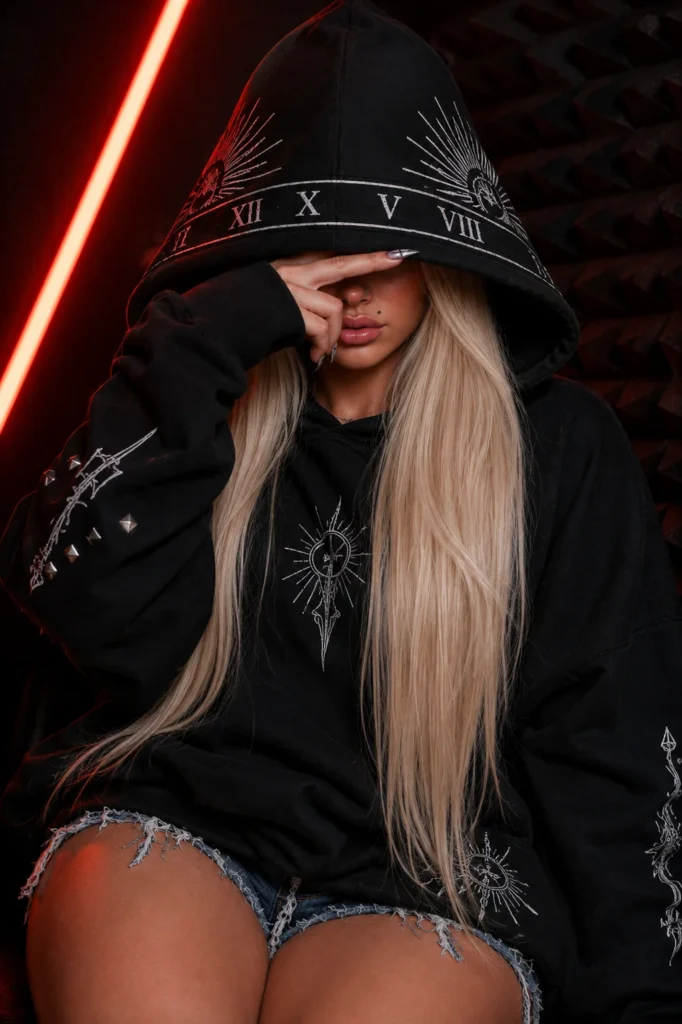
Garota Dark Aesthetic com Visual Urbano e Misterioso
Garota dark aesthetic é uma das pesquisas mais populares entre criadores de conteúdo visual, artistas digitais e entusiastas de imagens geradas por IA. Esta composição reúne elementos que definem perfeitamente essa estética: iluminação dramática, moda alternativa e uma atmosfera carregada de personalidade.
Uma Presença Que Domina a Cena
A personagem surge envolta por um moletom oversized preto, com o capuz projetando sombras sobre parte do rosto. O contraste entre os cabelos claros e a iluminação vermelha cria uma narrativa visual intensa, quase cinematográfica.
O ambiente escuro reforça a sensação de mistério e transforma o retrato em algo que vai além de uma simples fotografia. Cada detalhe contribui para uma estética contemporânea que mistura streetwear, cultura alternativa e identidade visual marcante.
Prompt Gratuito Para Copiar
Se você deseja criar imagens semelhantes, existe um prompt gratuito e pronto para copiar inspirado nesta composição. Ele serve como ponto de partida para desenvolver personagens urbanos, retratos conceituais e cenas de forte impacto visual.
A proposta permite explorar diferentes interpretações mantendo a mesma atmosfera envolvente que torna esse estilo tão procurado.
Possibilidades de Variação
A cena pode ser adaptada para versões cyberpunk, fashion editorial, fotografia noturna, estética underground, neon urbano ou retratos de influência gótica contemporânea.
Criadores também podem experimentar mudanças de iluminação, ambientes industriais e elementos visuais inspirados em música, moda e cultura digital.
Inspiração Visual Que Conta Histórias
Assim como os trabalhos compartilhados por criadores como Loly Monteiro, esta imagem mostra como uma composição bem construída pode transmitir identidade, emoção e presença em um único enquadramento.
Prompt da imagem
Prompt 123:
A single adult subject occupies the center-right portion of a vertically framed image, shown from approximately mid-thigh upward in a seated position. The camera is positioned slightly below eye level and angled upward toward the subject. The subject’s torso is angled slightly toward the viewer’s left while the head is lowered and tilted slightly downward. A large black hood is pulled forward over the upper face, obscuring the eyes and most of the forehead. The visible portion of the face is directed generally toward the camera. The left arm is raised across the front of the face, with the hand positioned horizontally beneath the hood edge. The index and middle fingers extend across the face area, partially covering the nose bridge region, while the remaining fingers are bent inward. Fingertips point toward the viewer’s right. The right arm is largely outside the visible frame.
The subject wears an oversized black hooded sweatshirt made of thick matte fabric with visible folds, creases, and draping. The hood is large and structured, extending forward beyond the forehead. White printed graphic elements cover multiple areas of the garment. Across the front edge of the hood is a horizontal band containing white Roman numerals, including “XII,” “X,” “V,” and “VIII,” arranged along the band. Additional white radiating graphic motifs appear on both sides of the hood. White graphic line illustrations are visible on the chest area, sleeve, and lower right side of the garment. The left sleeve displays a vertical white graphic element and a row of small metallic pyramid-shaped studs near the forearm. The sweatshirt has loose sleeves and a relaxed fit with substantial fabric volume.
Long straight hair emerges from beneath the hood on both sides of the face and falls vertically over the front of the sweatshirt. The hair extends well below the shoulders, appearing smooth with minimal wave, a central-to-slight off-center parting, and even distribution on both sides.
Only the lower portion of the face is visible beneath the hood. The eyes are obscured by shadow and the hood edge. The nose is partially visible. The lips are closed and clearly defined. Portions of the eyebrows and eyelashes are not visible due to occlusion. The jawline is partially visible along the lower face contour.
The raised hand displays long, pointed fingernails with light-colored decorative patterns and glossy surfaces. No rings are visible. The face shows visible cosmetic detailing including defined lip coloration and subtle contouring around the visible facial areas.
The background consists of a dark interior environment. On the left side of the frame, a bright linear light source runs diagonally from upper left toward lower center-left, emitting a strong red-orange glow. Behind the subject on the right side is a wall covered with dark acoustic foam panels arranged in a repeating geometric wedge pattern. The background recedes into darker tones, creating depth behind the subject.
Lighting is dominated by red-orange illumination originating from the left side of the frame. This light casts colored highlights along the left edge of the hood, hair, hand, and face. Additional softer neutral illumination reveals details on the garment graphics and lower facial features. Shadows are present beneath the hood and around garment folds. No mirrors, glass surfaces, or visible reflections are present. The image contains no visible furniture, tattoos, jewelry, or additional accessories beyond the clothing, printed graphics, metallic sleeve studs, and decorated fingernails.
Use the provided reference person as the primary source for identity and body shape. The reference defines the character’s face.
Do not copy clothing, pose, background, lighting, camera angle, or environment from the reference image.
Body Fidelity — Highest Priority:
Preserve the shortstack proportions of the reference person, natural body width, body mass, soft body characteristics, weight distribution, torso-to-leg proportion, limb thickness, shoulder width, waist shape, hip shape, thigh volume, arm volume, and overall silhouette.
Maintain the visible natural body volume and softness consistent with the reference person.
Do not reduce body mass. Do not elongate limbs. Do not slim down the arms, thighs, hips, or torso.
Identity Fidelity:
Preserve the facial structure, skin tone and undertone, natural skin texture, pores, asymmetries, imperfections, and hair color of the reference person.
Do not beautify, stylize, smooth, reshape, normalize, balance, or idealize the face or body.
Hair: Use the hairstyle from the extracted scene, but apply only the natural hair color and texture of the reference person.
Pose: Preserve the pose from the extracted scene, but adapt it naturally to the original body proportions and mass of the reference person. Do not force the pose to create a slimmer or elongated body.
Clothing and Details:
Preserve the clothing, accessories, materials, seams, textures, jewelry, nails, reflections, folds, and object interactions from the extracted scene.
**Negative Restrictions:**
No slimming, no leg elongation, no beauty correction, no athletic normalization, no skin smoothing, no stylization, no pose reinterpretation, no clothing change, no background change, no lighting alteration.
Output Format:
Vertical portrait composition, resolution 1080 × 1920.