
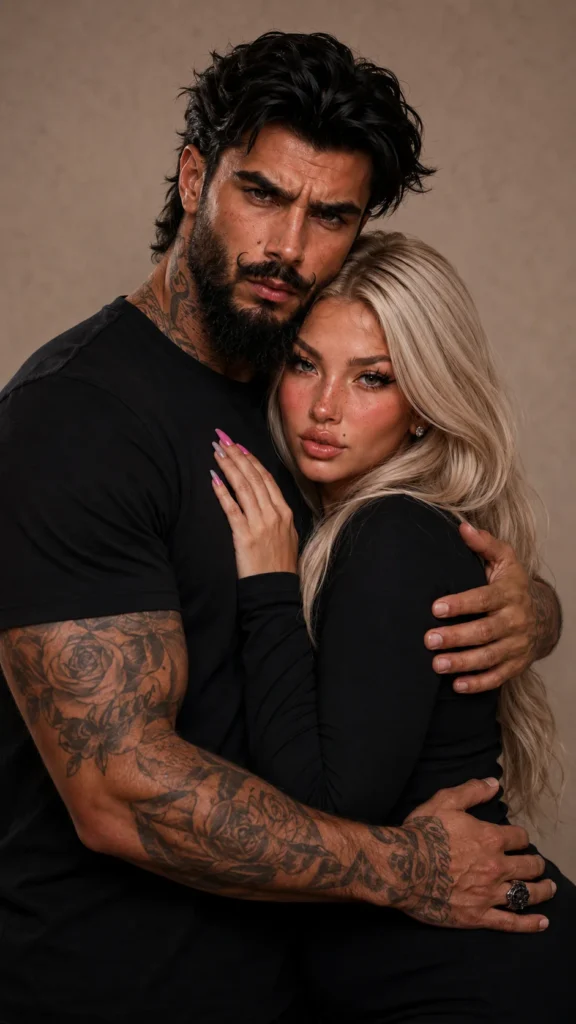
O impacto visual de um casal hiper-realista
Casal hiper-realista é uma das tendências visuais mais procuradas por quem busca criar imagens marcantes com inteligência artificial. A combinação entre detalhes refinados, iluminação dramática e personagens de forte presença transforma uma simples composição em uma cena memorável.
Uma estética que chama atenção
Nesta imagem, dois personagens aparecem lado a lado em um retrato de estúdio cuidadosamente construído. O contraste entre a força visual do personagem masculino e o visual sofisticado da personagem feminina cria equilíbrio e intensidade.
O fundo escuro direciona completamente o olhar para os protagonistas, enquanto os reflexos, texturas e acabamentos contribuem para uma aparência quase fotográfica. O resultado é uma obra que mistura moda, arte digital e narrativa visual contemporânea.
Prompt gratuito para copiar
Para quem deseja recriar esse estilo, existe um prompt gratuito e pronto para copiar inspirado nesta composição. Ele pode servir como ponto de partida para gerar retratos cinematográficos, personagens digitais, capas visuais e artes conceituais de alto impacto.
Possibilidades criativas
A mesma base visual pode ser adaptada para cenários futuristas, editoriais de moda, personagens de jogos, campanhas publicitárias, capas para redes sociais ou conceitos de fantasia moderna.
Artistas digitais e criadores de conteúdo frequentemente exploram esse tipo de composição para produzir imagens que geram cliques, compartilhamentos e forte engajamento visual.
Criada para impressionar à primeira vista, esta estética mostra como um único retrato pode transmitir personalidade, presença e narrativa em uma única cena.
Conteúdo inspirado por tendências visuais exploradas por criadores como Loly Monteiro
Prompt da imagem
A tightly framed vertical portrait showing two adults positioned close together against a plain, softly textured background. The camera is at approximately eye level and captures both subjects from the upper torso upward. The adult male occupies the left side of the frame and is positioned slightly forward. The adult female occupies the right side of the frame and is partially enclosed within the male subject’s arms. Both subjects face generally toward the camera. The male subject’s head is tilted slightly downward and inward toward the female subject. The female subject’s head rests beneath and against the left side of the male subject’s jaw and neck area, with her face angled slightly upward toward the camera. The male subject’s torso is turned slightly toward the right side of the frame. The female subject’s torso is turned slightly toward the left side of the frame and partially obscured by the male subject’s body and arms. The male subject’s right arm extends across the front of the female subject’s upper body and curves around her back, with the right hand visible along the right edge of the frame. The right thumb rests along the outer side of her upper arm or shoulder area while the remaining fingers curve around behind her. The male subject’s left arm crosses the lower foreground of the image, wrapping around the female subject’s midsection. His left hand is visible in the lower right portion of the frame with fingers naturally curved and resting against her side. A ring is visible on one finger of the left hand. The female subject’s visible hand rests against the male subject’s chest area, with fingers gently bent and placed on the fabric of his shirt. The adult male wears a dark short-sleeved crew-neck shirt with a smooth, matte appearance and minimal visible seams. The fabric appears lightweight with slight folds around the shoulder and chest areas. The adult female wears a dark long-sleeved top with a smooth surface and a matte finish. The fabric drapes naturally with soft folds visible along the shoulder and sleeve. No transparency is visible in either garment. The male subject has short-to-medium length hair with substantial volume at the top, irregular textured strands, and a slightly tousled structure. The hair extends downward around the sides and back with layered sections visible near the ears and forehead. The female subject has long hair extending beyond the shoulders, with a center part and loose strands framing both sides of the face. The hair falls naturally along the shoulders and back with soft waves and moderate volume. The male subject’s face shows visible eyebrows with a dense shape, almond-shaped eyes directed toward the camera, a straight nose, closed lips, light facial stubble along the jaw, chin, and upper lip, and a defined jawline. The female subject’s face shows visible eyebrows, almond-shaped eyes directed toward the camera, visible eyelashes, a straight nose, closed lips, and a softly defined jawline. A small stud earring is visible in the female subject’s ear. Subtle cosmetic detailing is visible around the eyes and lips. The male subject has multiple visible tattoos. A large tattoo is present on the left side of the neck, extending upward from below the collar line. Extensive tattoo work covers much of the visible left forearm and extends across the upper arm, containing multiple overlapping dark shapes and linework. Additional tattoo elements are visible on the right forearm and wrist area. Fingernails visible on both subjects appear short and natural. The background consists of a neutral-toned wall or backdrop with soft tonal variation and no visible objects, furniture, mirrors, glass surfaces, or reflections. Lighting is soft and diffuse, illuminating both subjects evenly with gentle shadows along facial contours, beneath the chin areas, and within folds of clothing. Depth of field is shallow, keeping the subjects in focus while the background remains softly blurred.
Use the provided reference person as the primary source for identity and body shape. The reference defines the character’s face.
Do not copy clothing, pose, background, lighting, camera angle, or environment from the reference image.
Body Fidelity — Highest Priority:
Preserve the shortstack proportions of the reference person, natural body width, body mass, soft body characteristics, weight distribution, torso-to-leg proportion, limb thickness, shoulder width, waist shape, hip shape, thigh volume, arm volume, and overall silhouette.
Maintain the visible natural body volume and softness consistent with the reference person.
Do not reduce body mass. Do not elongate limbs. Do not slim down the arms, thighs, hips, or torso.
Identity Fidelity:
Preserve the facial structure, skin tone and undertone, natural skin texture, pores, asymmetries, imperfections, and hair color of the reference person.
Do not beautify, stylize, smooth, reshape, normalize, balance, or idealize the face or body.
Hair: Use the hairstyle from the extracted scene, but apply only the natural hair color and texture of the reference person.
Pose: Preserve the pose from the extracted scene, but adapt it naturally to the original body proportions and mass of the reference person. Do not force the pose to create a slimmer or elongated body.
Clothing and Details:
Preserve the clothing, accessories, materials, seams, textures, jewelry, nails, reflections, folds, and object interactions from the extracted scene.
**Negative Restrictions:**
No slimming, no leg elongation, no beauty correction, no athletic normalization, no skin smoothing, no stylization, no pose reinterpretation, no clothing change, no background change, no lighting alteration.
Output Format:
Vertical portrait composition, resolution 1080 × 1920.