
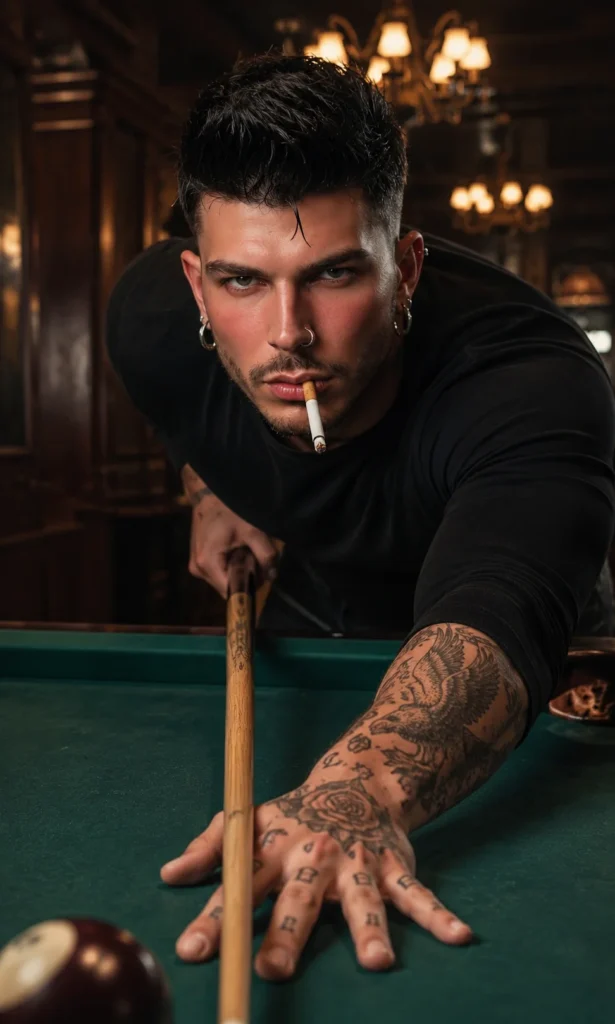
Modelo masculino bilhar cinematica com estética editorial
A estética de modelo masculino bilhar cinematica combina tensão visual, iluminação quente e composição cinematográfica em um retrato que parece saído de um filme noir contemporâneo. A cena cria imediatamente uma sensação de profundidade e presença, especialmente pelo ângulo baixo da câmera e pelo taco de sinuca conduzindo o olhar até o personagem.
Atmosfera sofisticada e urbana
O ambiente escuro com lustres desfocados transforma o cenário em algo elegante e intimista. As tatuagens detalhadas, os piercings metálicos e o figurino preto ajustado reforçam uma identidade visual moderna, intensa e editorial.
A iluminação valoriza textura de pele, acessórios e expressão facial sem exageros artificiais, mantendo um visual natural e extremamente fotográfico. O resultado funciona muito bem para referências de retrato masculino premium, campanhas fashion, capas para Pinterest e coleções visuais com estética dark luxury.
Prompt gratuito para copiar
Se você procura criar imagens semelhantes em IA, este conteúdo inclui um prompt gratuito pronto para copiar. A estrutura visual da cena ajuda a reproduzir enquadramentos cinematográficos, profundidade realista, iluminação quente e composição editorial com alta fidelidade estética.
Possibilidades criativas
A mesma direção visual pode ser adaptada para estilos neo-noir, retratos urbanos, editoriais de moda masculina, personagens misteriosos ou cenas inspiradas em clubes vintage sofisticados.
É uma referência visual forte para quem deseja criar imagens marcantes, realistas e cheias de atmosfera.
Prompt da imagem
Prompt 121:
A vertically framed close-up image shows an adult person leaning over a green billiards table while holding a wooden pool cue diagonally from the lower foreground toward the center of the frame. The camera angle is low and positioned near table height, creating strong foreground perspective with the cue and the subject’s left hand extending toward the viewer. The subject occupies the central portion of the image, with the head positioned slightly above center and the arm extending downward across the lower right area of the frame. A blurred billiard ball is partially visible in the extreme lower left foreground. The background contains warm indoor lighting with multiple chandelier fixtures rendered out of focus, dark wooden architectural elements, and dim ambient depth extending behind the subject.
The subject’s torso is angled forward over the table surface with the shoulders lowered and the head tilted slightly downward while facing directly toward the camera. The face is oriented forward with both eyes visible and aligned toward the lens. One arm extends toward the foreground along the billiards table surface while gripping or guiding the cue. The visible hand rests flat against the table with fingers spread apart around the cue shaft; the index and middle fingers are extended forward while the cue passes between the fingers. Fingernails are short and unpainted.
The subject wears a fitted black long-sleeve top with a smooth matte texture and close body fit. The sleeves extend fully to the wrists without visible folds or seams emphasized by lighting. No outerwear is visible.
The hairstyle is medium length with layered textured strands and high volume concentrated at the top. Hair is swept upward and backward with loose strands falling forward across the forehead. The sides appear shorter and closer to the head while the top retains significant lift and separation. Individual strands are visible under directional overhead lighting.
Facial structure shows defined eyebrows, visible eyelashes, a straight nose, and closed lips holding a cigarette angled slightly downward from the center of the mouth. The jawline is sharply defined. The skin surface appears smooth with visible natural texture and light shadow transitions from overhead lighting.
Jewelry includes multiple metallic hoop earrings on both ears and a metallic nose ring positioned through one nostril. The earrings are reflective and circular with varying diameters. Tattoos cover much of the visible forearm and hand, including a large eagle with wings spread, multiple rose designs, and smaller symbols or lettering near the fingers. The tattoo ink appears dark with shaded gradients and outlines. Small finger tattoos are visible across the knuckles. No visible makeup is apparent beyond natural facial definition.
Lighting is warm and directional from overhead chandeliers, creating highlights along the hair structure, nose bridge, cheekbones, jewelry, and cue shaft while casting softer shadows beneath the chin, arm, and hand. Metallic surfaces such as the earrings and nose ring show small specular reflections. The billiards table felt has a matte green texture with slight visible wear and soft shadowing around the hand and cue.
Use the provided reference person as the primary source for identity and body shape. The reference defines the character’s face.
Do not copy clothing, pose, background, lighting, camera angle, or environment from the reference image.
Body Fidelity — Highest Priority:
Preserve the shortstack proportions of the reference person, natural body width, body mass, soft body characteristics, weight distribution, torso-to-leg proportion, limb thickness, shoulder width, waist shape, hip shape, thigh volume, arm volume, and overall silhouette.
Maintain the visible natural body volume and softness consistent with the reference person.
Do not reduce body mass. Do not elongate limbs. Do not slim down the arms, thighs, hips, or torso.
Identity Fidelity:
Preserve the facial structure, skin tone and undertone, natural skin texture, pores, asymmetries, imperfections, and hair color of the reference person.
Do not beautify, stylize, smooth, reshape, normalize, balance, or idealize the face or body.
Hair: Use the hairstyle from the extracted scene, but apply only the natural hair color and texture of the reference person.
Pose: Preserve the pose from the extracted scene, but adapt it naturally to the original body proportions and mass of the reference person. Do not force the pose to create a slimmer or elongated body.
Clothing and Details:
Preserve the clothing, accessories, materials, seams, textures, jewelry, nails, reflections, folds, and object interactions from the extracted scene.
**Negative Restrictions:**
No slimming, no leg elongation, no beauty correction, no athletic normalization, no skin smoothing, no stylization, no pose reinterpretation, no clothing change, no background change, no lighting alteration.
Output Format:
Vertical portrait composition, resolution 1080 × 1920.