
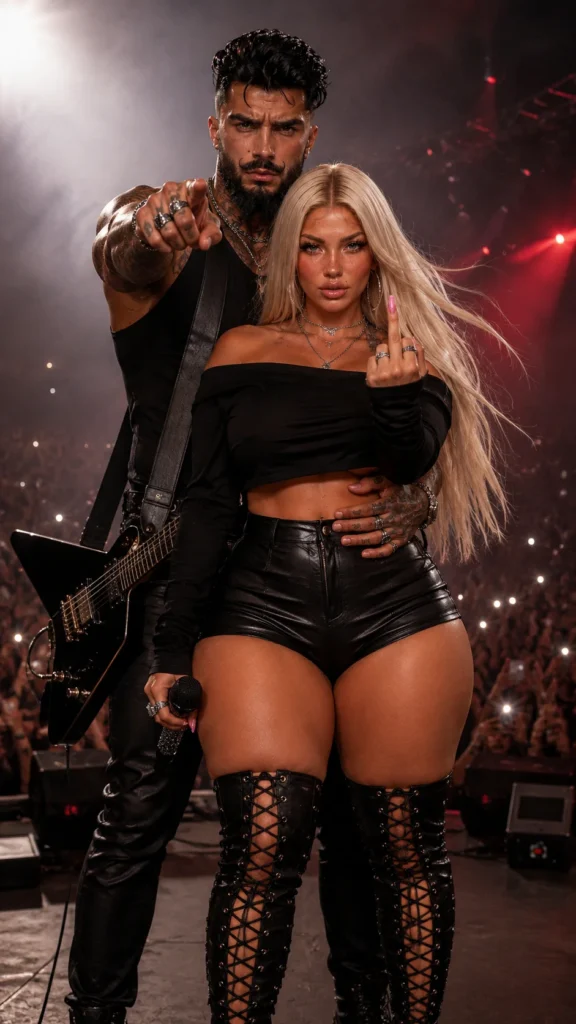
Rockstar casal no palco com IA é uma proposta visual que mistura música, moda alternativa e uma atmosfera de espetáculo com forte presença artística. A cena retrata dois personagens em um momento de pura atitude, com iluminação de show, fumaça no ar e uma conexão intensa diante do público.
Uma estética de concerto com personalidade
Os detalhes do figurino escuro, das peças em couro, das joias metálicas e da guitarra criam uma identidade inspirada no universo do rock moderno. A composição vertical reforça a sensação de estar diante de um pôster de apresentação musical ou de uma capa de álbum.
A combinação entre expressão, postura e cenário transforma a imagem em uma referência interessante para artistas digitais, criadores de conteúdo e apaixonados por composições visuais de alto impacto.
Copie gratuitamente o prompt desta imagem
Se você deseja recriar essa estética, o prompt visual utilizado como inspiração está disponível gratuitamente para copiar. Ele foi pensado para auxiliar na criação de cenas de palco com personagens marcantes, iluminação dramática e elementos visuais ricos, seguindo uma direção artística semelhante à explorada por criadores como Loly Monteiro.
Explore novas possibilidades visuais
Esse conceito pode ser adaptado para diferentes estilos, como fotografia editorial, capas de álbuns, moda alternativa, cenas de festival, apresentações ao vivo ou retratos cinematográficos de personagens.
Cada variação permite explorar novas histórias, emoções e atmosferas através da criação visual.
Prompt da imagem:
A vertically framed image shows two adult subjects positioned at the center of a stage scene, captured from a slightly low frontal camera angle with both figures occupying most of the foreground. The front subject stands slightly ahead of the second subject, with the body facing forward and the head directed toward the camera. The rear subject stands closely behind, also facing forward with the head directed toward the camera. The rear subject’s left arm extends around the front subject’s waist area with the hand resting across the side of the garment, while the right arm extends forward toward the camera with the hand raised and the index finger extended. The front subject’s right arm is bent upward with the hand raised near the chest area and the middle finger extended, while the left hand holds a microphone near the lower left side of the frame with the microphone angled downward.
The front subject wears a dark long-sleeved cropped top with a loose draped structure and an off-shoulder neckline exposing the upper shoulder area. The garment has soft folds and a matte fabric appearance. The subject wears dark high-waisted shorts with a smooth reflective surface, visible seams, fitted structure, and slight light reflections along the material. Tall lace-up footwear extends upward from below the knee area, featuring multiple eyelets, visible laces, open patterned sections, and a dark textured surface. Several rings are visible on the fingers, and layered necklaces with thin chains and small pendant elements are worn around the neck.
The rear subject wears a dark sleeveless fitted shirt with a smooth matte surface and dark fitted pants with a slightly reflective material. A guitar strap extends diagonally across the torso, supporting a dark electric guitar positioned along the right side of the image. Multiple rings are visible on the extended hand. Visible tattoos appear on the neck, shoulder, arm, and hand areas.
The front subject’s hair is long with a side part, high volume, loose waves, and strands flowing outward toward the left side of the image, creating visible movement. The rear subject’s hair is short to medium length with layered strands, volume at the top, and sections falling slightly forward around the forehead.
Both faces show visible eyebrows with defined shape, visible eyelashes, open eyes directed toward the camera, straight nose structures, defined lips in a relaxed closed position, and clear jawline contours. The front subject displays visible makeup details including defined eyebrow shaping, dark eyelash enhancement, smooth complexion appearance, and lip coloration.
The environment shows a concert stage with a blurred audience occupying the background. Multiple small bright lights from audience devices appear throughout the lower background. A strong light source enters from the upper left side, creating a bright illuminated area and visible atmospheric haze or smoke across the upper portion of the scene. Additional red lighting appears from the right side, creating colored illumination and shadows around the subjects. The stage floor is visible at the bottom of the frame, including stage equipment near the lower corners. Metallic elements on the microphone, guitar hardware, jewelry, and rings show small reflective highlights. The background remains out of focus with visible depth separation between the subjects and the audience.
Use the provided reference person as the primary source for identity and body shape. The reference defines the character’s face.
Do not copy clothing, pose, background, lighting, camera angle, or environment from the reference image.
Body Fidelity — Highest Priority:
Preserve the shortstack proportions of the reference person, natural body width, body mass, soft body characteristics, weight distribution, torso-to-leg proportion, limb thickness, shoulder width, waist shape, hip shape, thigh volume, arm volume, and overall silhouette.
Maintain the visible natural body volume and softness consistent with the reference person.
Do not reduce body mass. Do not elongate limbs. Do not slim down the arms, thighs, hips, or torso.
Identity Fidelity:
Preserve the facial structure, skin tone and undertone, natural skin texture, pores, asymmetries, imperfections, and hair color of the reference person.
Do not beautify, stylize, smooth, reshape, normalize, balance, or idealize the face or body.
Hair: Use the hairstyle from the extracted scene, but apply only the natural hair color and texture of the reference person.
Pose: Preserve the pose from the extracted scene, but adapt it naturally to the original body proportions and mass of the reference person. Do not force the pose to create a slimmer or elongated body.
Clothing and Details:
Preserve the clothing, accessories, materials, seams, textures, jewelry, nails, reflections, folds, and object interactions from the extracted scene.
**Negative Restrictions:**
No slimming, no leg elongation, no beauty correction, no athletic normalization, no skin smoothing, no stylization, no pose reinterpretation, no clothing change, no background change, no lighting alteration.
Output Format:
Vertical portrait composition, resolution 1080 × 1920.