
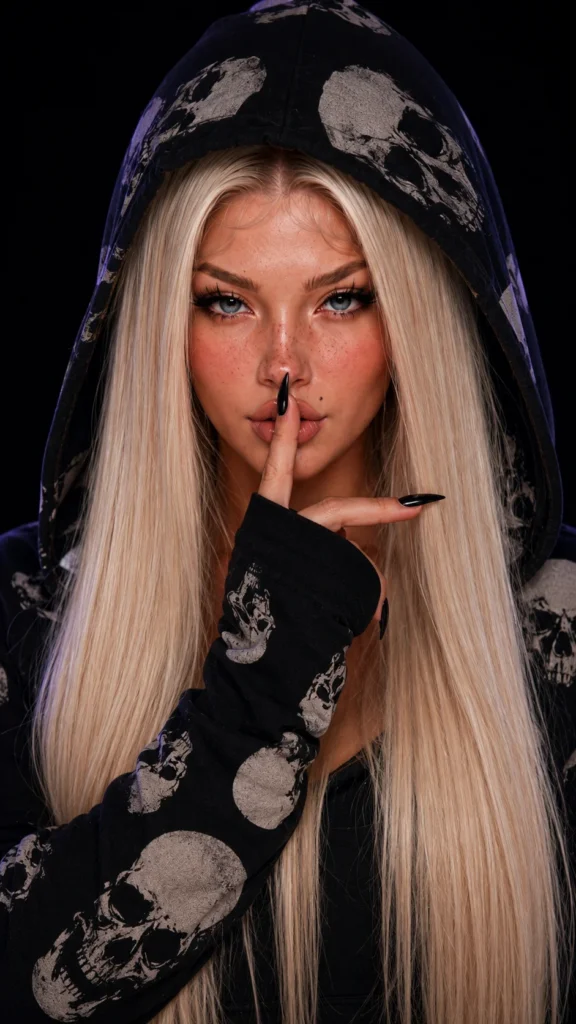
O poder de um retrato gótico feminino
O retrato gótico feminino é uma das estéticas mais procuradas por criadores de imagens com IA que buscam combinar beleza sombria, expressão marcante e atmosfera cinematográfica. Nesta composição, o olhar direto, o gesto de silêncio e o capuz estampado com crânios criam uma narrativa visual carregada de mistério.
Uma estética sombria e elegante
A combinação entre o fundo escuro, a iluminação direcionada e os detalhes realistas da pele e dos tecidos constrói uma cena que lembra editoriais de moda alternativa e retratos conceituais. Cada elemento reforça uma identidade visual intensa, onde o contraste entre delicadeza e obscuridade se torna o principal destaque.
Copie gratuitamente o prompt desta imagem
Para quem deseja recriar essa atmosfera ou desenvolver novas interpretações, o prompt completo desta imagem está disponível gratuitamente para copiar. Ele foi pensado para servir como ponto de partida para diferentes estilos de retratos sombrios, personagens de fantasia moderna ou composições artísticas inspiradas na estética de Loly Monteiro.
Possibilidades criativas
O conceito pode ser adaptado para visuais cyber góticos, moda dark, retratos cinematográficos, capas de projetos criativos e identidades visuais marcantes. Pequenas mudanças na expressão, maquiagem, roupas ou iluminação permitem explorar novas narrativas mantendo a força visual da composição.
Uma única imagem pode revelar uma história inteira. Copie o prompt e transforme essa inspiração em novas criações visuais.
Prompt da imagem:
A close-up vertical portrait of an adult subject centered in the frame, captured from a straight-on camera angle at eye level. The head and upper torso occupy most of the composition, with the face positioned centrally and the subject facing directly toward the camera. The head is slightly lowered and remains aligned forward. One hand is raised in front of the lower face, with the index finger placed vertically near the center of the lips and another finger extended diagonally downward, forming a V-like hand arrangement. The hand partially covers the lower portion of the face.
The subject wears a dark hooded garment pulled over the head. The fabric displays a repeated high-contrast skull pattern in light tones across the hood and sleeves. The garment includes long sleeves extending over part of the hands, with a fitted appearance around the wrists and fingers. The fabric appears soft and matte with visible folds, creases, and stretching where it follows the hand position.
The hair is long, straight, and smooth, extending down both sides of the face and past the visible lower frame area. It has a central to slightly off-center parting and falls vertically with minimal movement.
The face shows visible eyes looking directly toward the camera, defined eyebrows with a structured shape, long visible eyelashes, a straight nose, and closed lips with a clearly defined outline. The jawline is visible beneath the hair. Makeup is visible, including dark eyeliner around the eyes, blended eye shadow, defined eyebrows, foundation with an even surface, and colored lip makeup.
The fingernails are long, pointed, and finished with a dark glossy coating. No visible jewelry, tattoos, glasses, or additional accessories are present.
The background is very dark and lacks distinguishable objects or structures. Low-key lighting illuminates the face and front of the subject, with subtle colored light accents visible along parts of the garment and hair. Shadows are present around the hood, the sides of the face, and the surrounding background, creating strong contrast between the subject and the environment.
Use the provided reference person as the primary source for identity and body shape. The reference defines the character’s face.
Do not copy clothing, pose, background, lighting, camera angle, or environment from the reference image.
Body Fidelity — Highest Priority:
Preserve the shortstack proportions of the reference person, natural body width, body mass, soft body characteristics, weight distribution, torso-to-leg proportion, limb thickness, shoulder width, waist shape, hip shape, thigh volume, arm volume, and overall silhouette.
Maintain the visible natural body volume and softness consistent with the reference person.
Do not reduce body mass. Do not elongate limbs. Do not slim down the arms, thighs, hips, or torso.
Identity Fidelity:
Preserve the facial structure, skin tone and undertone, natural skin texture, pores, asymmetries, imperfections, and hair color of the reference person.
Do not beautify, stylize, smooth, reshape, normalize, balance, or idealize the face or body.
Hair: Use the hairstyle from the extracted scene, but apply only the natural hair color and texture of the reference person.
Pose: Preserve the pose from the extracted scene, but adapt it naturally to the original body proportions and mass of the reference person. Do not force the pose to create a slimmer or elongated body.
Clothing and Details:
Preserve the clothing, accessories, materials, seams, textures, jewelry, nails, reflections, folds, and object interactions from the extracted scene.
**Negative Restrictions:**
No slimming, no leg elongation, no beauty correction, no athletic normalization, no skin smoothing, no stylization, no pose reinterpretation, no clothing change, no background change, no lighting alteration.
Output Format:
Vertical portrait composition, resolution 1080 × 1920.